Each product available on the platform is listed and sold by a partner seller identified on the product page. The platform acts as a metasearch/marketplace: it facilitates discovery and checkout, but the sale is made by the seller, who becomes responsible for the transaction.
Shipping is managed directly by the partner seller. The package is sent from the seller's warehouse or logistics network and handed over to the courier. This model enables more efficient deliveries and ensures that order management is handled by the party with actual availability of the product.
On the product page, you will find ingredients, allergens and nutritional information based on the data provided by the seller or producer, namely the official label. If you have allergies or intolerances, we recommend carefully checking the product page before purchasing and contacting the seller with any specific questions.
The platform was created to promote Italian food and make it more accessible. We select sellers in the food e-commerce sector with consistent catalogs and transparent information. Each product is associated with an identifiable seller and a complete information page: we want shopping here to mean buying with confidence.
Delivery times and costs depend on the seller and destination. At checkout, you will always find an updated delivery estimate before confirming payment. For international shipments, times may vary depending on the country and courier.
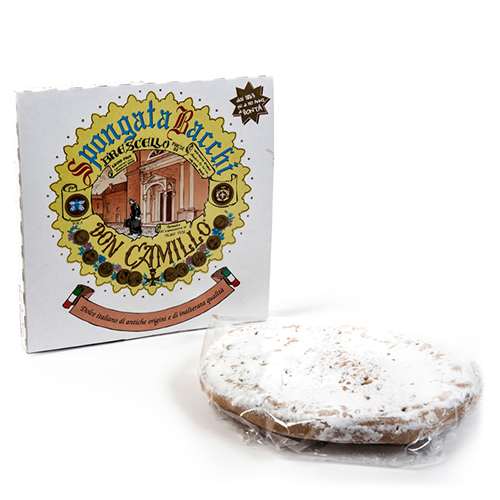
The cake called “Spongata” is an ancient baked confection typical of the Reggio Emilia area, with its epicenter in Brescello in the province of Parma. It is a very old product, whose origins are not entirely clear, but traces of a dessert similar to the present-day one can already be found in medieval times. Today, the one produced by our company is a round cake made with a shortcrust pastry shell, covered with a layer of white powdered sugar, enclosing a sweet filling with a slightly spiced aftertaste and a soft texture. The story of Don Camillo’s Spongata The town of Brescello is famous not only for Guareschi’s successful saga (Don Camillo and Peppone), but also for a delicious dessert: the Spongata cake, which our company chose to name after this character known and loved by everyone. What is it? It is a very rich baked dessert, with a shortcrust pastry shell containing a special dark-brown filling made with almonds, orange cubes, sultanas, honey, butter, apricot jam, spices and flavorings. The historical origin Its origin is extremely ancient, as is the case with many desserts produced in our beautiful Italy, more or less with the same ingredients. It seems to date back to the mid-fifteenth century, although it only became typical of Emilia’s gastronomic tradition from the second half of the nineteenth century. Production began in 1863 with the family of Domenico Bacchi and continues today as it did then, still made by hand.
Price including VAT
The cake called “Spongata” is an ancient baked confection typical of the Reggio Emilia area, with its epicenter in Brescello in the province of Parma. It is a very old product, whose origins are not entirely clear, but traces of a dessert similar to the present-day one can already be found in medieval times. Today, the one produced by our company is a round cake made with a shortcrust pastry shell, covered with a layer of white powdered sugar, enclosing a sweet filling with a slightly spiced aftertaste and a soft texture. The story of Don Camillo’s Spongata The town of Brescello is famous not only for Guareschi’s successful saga (Don Camillo and Peppone), but also for a delicious dessert: the Spongata cake, which our company chose to name after this character known and loved by everyone. What is it? It is a very rich baked dessert, with a shortcrust pastry shell containing a special dark-brown filling made with almonds, orange cubes, sultanas, honey, butter, apricot jam, spices and flavorings. The historical origin Its origin is extremely ancient, as is the case with many desserts produced in our beautiful Italy, more or less with the same ingredients. It seems to date back to the mid-fifteenth century, although it only became typical of Emilia’s gastronomic tradition from the second half of the nineteenth century. Production began in 1863 with the family of Domenico Bacchi and continues today as it did then, still made by hand.