Emporion
5.0
23 reviews · Google Maps

Follow us on social media:

DrillDown s.r.l. Viale Isonzo, 8, 20135 - Milano (MI)VAT: 12392590969
About usPrivacy policyCookie policyTerms and ConditionsHow it worksReturn policyBecome a partner and sell with usGeneral Terms of Use of the Tuduu platform (Professional Users)
Withdrawal, return and cancellation

Sign up

Sign up to access exclusive offers

Secure payments

  • Visa
  • Mastercard
  • American Express
  • Apple Pay
  • Google Pay
  • Klarna
  • Bancontact
  • iDEAL, Wero
  • Visa
  • Mastercard
  • American Express
  • Apple Pay
  • Google Pay
  • Klarna
  • Bancontact
  • iDEAL, Wero
Powered by Tuduu
Emporion
Cart
  • Stores
  • Products
  • Recipes
  1. Different regions, different pasta
  2. Five ways to cook pasta + 1
  3. Spaghetti all’assassina: a Puglian gem
Spaghetti and other shapes: 5 ways to cook pasta

Spaghetti and other shapes: 5 ways to cook pasta

Whether it is classic spaghetti or the less common regional shapes, there is no doubt: Italians are the biggest pasta eaters in the world, with over 23 kilos per person consumed annually. More than 1 in 2 Italians (54%) eat it every day, with lunch being the preferred meal for 8 out of 10 to do so (source: Nextplora 2024 analysis). And if abroad spaghetti are the most popular format when it comes to enjoying Italian cuisine, on national soil the variety of choice is instead extremely wide.

Different regions, different pasta

In Southern Italy, about 7 in 10 Italians (68%) eat pasta every day, compared with more than 4 in 10 in the Northwest (43%). According to a census by Unione Italiana Food, out of 500 existing pasta shapes, around 200 regional recipes have been documented. Short or long, smooth or ridged, hollow or filled: the different names and lines tell stories of territories, popular culture, production techniques, the craft and imagination of the pasta maker, and above all a product that has always been accessible and cross-cutting. Every region, every bell tower has its symbolic recipe, every Italian has their favorite. And considering that each region has, on average, between 7 and 10 typical pasta recipes with as many local variations, the exact number is practically impossible to count.

Five ways to cook pasta + 1

It is not only the shapes that differ, but also the ways to cook pasta, each with a different result. Here are the main five:

  1. Pasta in salted boiling water: This is the traditional method, which involves bringing a pot of plenty of salted water to a boil (about 1 liter of water for every 100 g of pasta and 10 g of coarse salt). Then you add the pasta and stir it from time to time to prevent sticking, cooking it until it reaches the desired texture. In Italy, the traditional texture is the so-called “al dente,” a contraction of the term “alla dentatura,” meaning that the pasta should still be firm when bitten.
  2. Risotto-style pasta: Start by sautéing the uncooked pasta in oil or butter with chopped onion or garlic. Then add broth or hot water a ladle at a time, stirring until the liquid has been fully absorbed before adding the next ladle.
  3. Baked pasta: This technique involves baking pasta that has been previously boiled in a sauce, such as béchamel and cheese or ragù. After combining all the ingredients, place everything in a baking dish and bake until the surface is golden and crispy.
  4. Cold pasta or pasta salad: After cooking the pasta by boiling (method number 1), drain it and run it under cold running water to stop the cooking. Then mix it with condiments such as vegetables, diced cheese, and fresh herbs to create a pasta salad. Note: yes to preserved vegetables in oil, but pickles are not recommended.
  • Creators
  • Media
  • About us
  • Pasta sautéed in a pan: After cooking the pasta by boiling (method number 1), but for about half the time indicated on the box, drain it and transfer it to a pan where the sauce has been prepared. Sauté the pasta over medium-high heat for a few minutes so the flavors blend well and the cooking is completed.
  • Fried pasta: Fried pasta is also a typical preparation of Italian cuisine, born as a leftover dish to reuse pasta that was left over. It is a technique that involves frying already cooked pasta, creating a crispy texture on the outside and soft on the inside. Depending on the region and the variations, fried pasta can be prepared in different ways, both sweet and savory.
  • Spaghetti all’assassina: a Puglian gem

    There is a sort of seventh cooking method, a toasting halfway between risotto-style pasta and fried pasta, whose emblem is a typical dish from the Bari area, but increasingly popular in the rest of Italy and beyond. We are talking about the so-called spaghetti all’assassina, one of the symbolic dishes of Puglian cuisine. Their origin is linked to local catering and the creativity of some cooks who wanted to give a twist to classic tomato pasta. The name "assassina" seems to derive from the spiciness of the dish and its intense, slightly burnt flavor, which can seem almost "deadly" to those not used to strong tastes. The recipe has been handed down in families and restaurants until it became a true gastronomic cult, complete with an Assassina Academy, created to preserve the tradition and promote the original preparation method. The special feature of the dish lies in the cooking method: the spaghetti are cooked raw directly in the pan without предварительное boiling and are risotto-style cooked with a tomato broth that makes them cook slowly while forming a crispy crust. The cast-iron pan is considered essential to achieve the right Maillard reaction, which gives the spaghetti their characteristic texture and slightly smoky flavor.
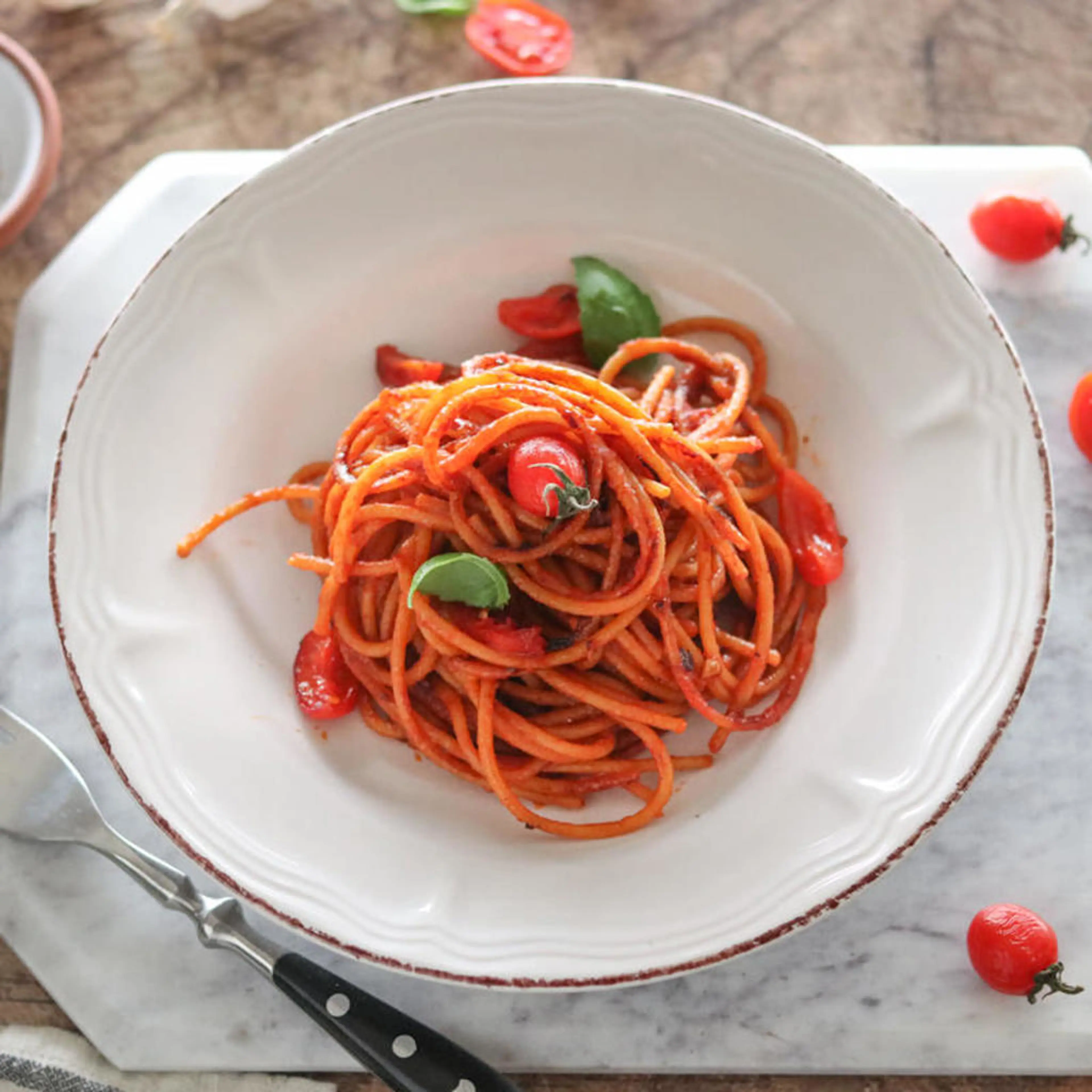

    Spaghetti all'assassina
    30 minEasy
    Em

    Spaghetti all'assassina

    Emporion