Each product available on the platform is listed and sold by a partner seller identified on the product page. The platform acts as a metasearch/marketplace: it facilitates discovery and checkout, but the sale is made by the seller, who becomes responsible for the transaction.
Shipping is managed directly by the partner seller. The package is sent from the seller's warehouse or logistics network and handed over to the courier. This model enables more efficient deliveries and ensures that order management is handled by the party with actual availability of the product.
On the product page, you will find ingredients, allergens and nutritional information based on the data provided by the seller or producer, namely the official label. If you have allergies or intolerances, we recommend carefully checking the product page before purchasing and contacting the seller with any specific questions.
The platform was created to promote Italian food and make it more accessible. We select sellers in the food e-commerce sector with consistent catalogs and transparent information. Each product is associated with an identifiable seller and a complete information page: we want shopping here to mean buying with confidence.
Delivery times and costs depend on the seller and destination. At checkout, you will always find an updated delivery estimate before confirming payment. For international shipments, times may vary depending on the country and courier.
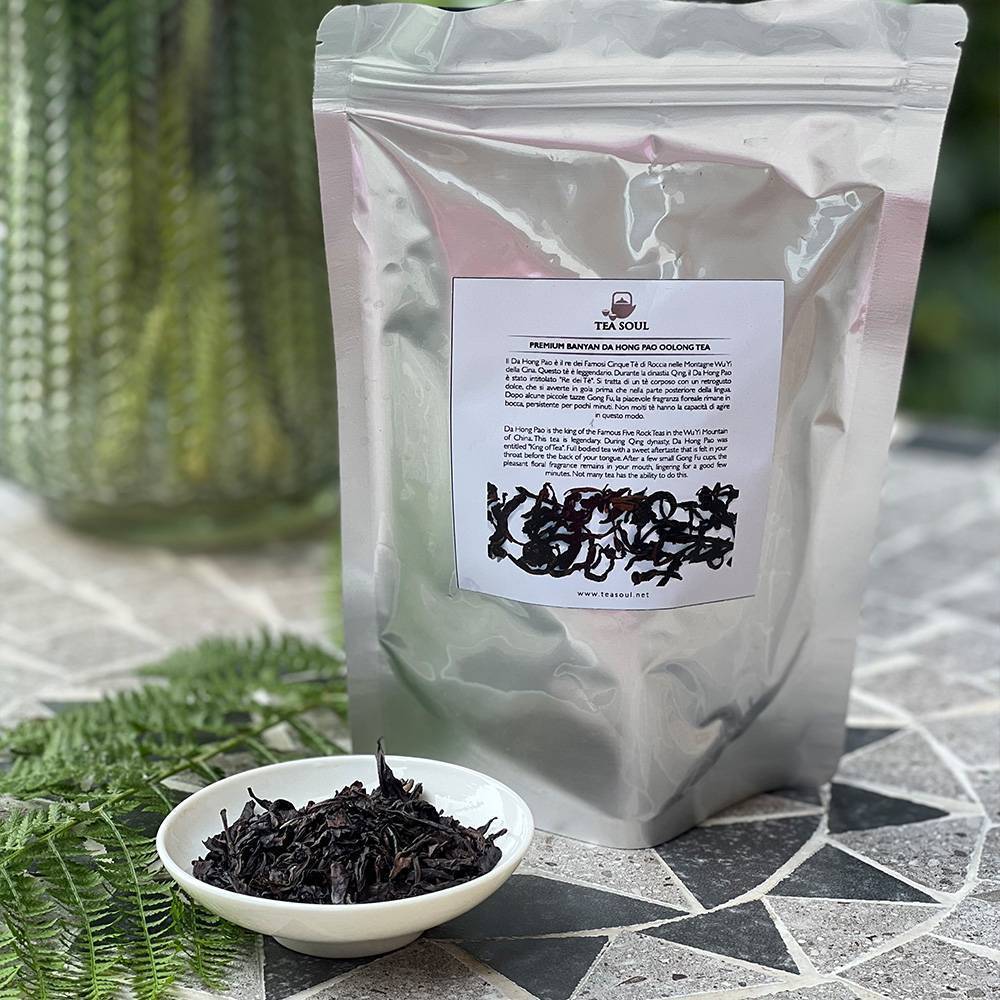
Da Hong Pao Banyan Oolong Tea belongs to the family of the celebrated Rock Teas (Yancha) of the Wuyi Mountains in the Chinese province of Fujian. Da Hong Pao is one of the best-known names among the oolongs produced in this area, and its history is also connected with some ancient plants growing near the Tian Xin temple. Da Hong Pao Banyan has an intense, full-bodied and complex aromatic profile, characterized by floral and fruity notes accompanied by toasted, sweet and mineral nuances. The liquor is smooth and enveloping, with a pleasant mineral component and a long, floral and sweet finish. The name Banyan refers to rock teas produced in the areas surrounding the zones most directly characterized by the rocky soils of the Wuyi Mountains. Compared with Da Hong Pao from the rockier areas, this tea has a more delicate and nuanced minerality. Tasting - Appearance and aroma: the leaves of Da Hong Pao Banyan Oolong Tea are large and rolled, with a deep brown color and bronze nuances. When infused, the leaves release intense aromas of fruit (redcurrant), rose and cocoa, as well as more delicate notes of wet rock, toasted nuts and sweet pipe tobacco. In the cup, the liquor is amber-colored, with an enveloping and velvety body. This is an extremely complex and elegant tea, with a truly astonishing aromatic range. Tasting notes - GONG FU CHA: the first infusion of Da Hong Pao Banyan Oolong Tea is characterized by very sweet notes of lychee and rose, followed by light toasted hints of nuts, such as pecans. With the second infusion, the range of flavors reveals countless nuances: notes of cocoa and petrichor appear, together with a pleasant sweet-and-salty contrast produced by the minerality, which is now more noticeable. Caramel notes (crème brûlée) and almond brittle also appear, with surprising sweetness. The third infusion and subsequent infusions bring out the floral aromas of rose again, along with fruity notes of plum and preserved cherry. The finish has aromas of toasted and caramelized dried fruit. WESTERN STYLE: the first sip of Da Hong Pao Banyan Oolong Tea opens with very sweet notes of lychee, rose and linden honey, followed by hints of sweet cocoa, caramelized almonds and walnuts. The toasted notes remain very gentle and the minerality is also moderate, although clearly perceptible on the palate. Notes of cherry liqueur may also be detected before the finish returns to floral and sweet honey aromas. Place of origin: Wuyi Mountains, northern area of Fujian province, China. Production: Da Hong Pao belongs to the Yancha family, the oolongs produced in the Wuyi Mountains region. The term does not identify a single cultivar, but includes various varieties and cultivars grown in the area and united by the particular local production tradition. Compared with low-oxidation oolongs, such as some Tie Guan Yin, Yancha teas generally undergo more extensive oxidation and more pronounced roasting. These elements contribute to the structure and aromatic characteristics typical of this tea family. The leaves are withered, processed to promote controlled oxidation, stabilized, then shaped and roasted. Roasting may be carried out in several stages, contributing to the development of dried-fruit, cocoa, wood and caramel notes. Infusion method: to infuse Da Hong Pao Banyan Oolong Tea, we recommend using Chinese purple clay (Yixing) or porcelain accessories. Warm the teapot with hot water before using it. For an Eastern-style infusion (gong fu cha), fill the Yixing teapot halfway with tea leaves, or use 5 grams of tea leaves for every 150 ml of water in a gaiwan. Heat the water to 90 °C: briefly rinse the leaves, then proceed with a first infusion of 25 seconds. Keeping the water at the same temperature, you can continue using the same leaves by adding more water and increasing the infusion time by 5 seconds each time (25 - 30 - 35…). This tea lasts for at least 6 infusions. For a more classic Western-style preparation, we recommend 3 grams of leaves in a 200 ml cup with water at 90 °C for an infusion time of 3 minutes. For the best tasting experience, we suggest filtering the tea as soon as the infusion time has elapsed. The infusion times we suggest may be slightly adjusted according to personal taste to obtain a more or less intense flavor. Store in a cool, dry place away from direct sunlight.
Price including VAT
Da Hong Pao Banyan Oolong Tea belongs to the family of the celebrated Rock Teas (Yancha) of the Wuyi Mountains in the Chinese province of Fujian. Da Hong Pao is one of the best-known names among the oolongs produced in this area, and its history is also connected with some ancient plants growing near the Tian Xin temple. Da Hong Pao Banyan has an intense, full-bodied and complex aromatic profile, characterized by floral and fruity notes accompanied by toasted, sweet and mineral nuances. The liquor is smooth and enveloping, with a pleasant mineral component and a long, floral and sweet finish. The name Banyan refers to rock teas produced in the areas surrounding the zones most directly characterized by the rocky soils of the Wuyi Mountains. Compared with Da Hong Pao from the rockier areas, this tea has a more delicate and nuanced minerality. Tasting - Appearance and aroma: the leaves of Da Hong Pao Banyan Oolong Tea are large and rolled, with a deep brown color and bronze nuances. When infused, the leaves release intense aromas of fruit (redcurrant), rose and cocoa, as well as more delicate notes of wet rock, toasted nuts and sweet pipe tobacco. In the cup, the liquor is amber-colored, with an enveloping and velvety body. This is an extremely complex and elegant tea, with a truly astonishing aromatic range. Tasting notes - GONG FU CHA: the first infusion of Da Hong Pao Banyan Oolong Tea is characterized by very sweet notes of lychee and rose, followed by light toasted hints of nuts, such as pecans. With the second infusion, the range of flavors reveals countless nuances: notes of cocoa and petrichor appear, together with a pleasant sweet-and-salty contrast produced by the minerality, which is now more noticeable. Caramel notes (crème brûlée) and almond brittle also appear, with surprising sweetness. The third infusion and subsequent infusions bring out the floral aromas of rose again, along with fruity notes of plum and preserved cherry. The finish has aromas of toasted and caramelized dried fruit. WESTERN STYLE: the first sip of Da Hong Pao Banyan Oolong Tea opens with very sweet notes of lychee, rose and linden honey, followed by hints of sweet cocoa, caramelized almonds and walnuts. The toasted notes remain very gentle and the minerality is also moderate, although clearly perceptible on the palate. Notes of cherry liqueur may also be detected before the finish returns to floral and sweet honey aromas. Place of origin: Wuyi Mountains, northern area of Fujian province, China. Production: Da Hong Pao belongs to the Yancha family, the oolongs produced in the Wuyi Mountains region. The term does not identify a single cultivar, but includes various varieties and cultivars grown in the area and united by the particular local production tradition. Compared with low-oxidation oolongs, such as some Tie Guan Yin, Yancha teas generally undergo more extensive oxidation and more pronounced roasting. These elements contribute to the structure and aromatic characteristics typical of this tea family. The leaves are withered, processed to promote controlled oxidation, stabilized, then shaped and roasted. Roasting may be carried out in several stages, contributing to the development of dried-fruit, cocoa, wood and caramel notes. Infusion method: to infuse Da Hong Pao Banyan Oolong Tea, we recommend using Chinese purple clay (Yixing) or porcelain accessories. Warm the teapot with hot water before using it. For an Eastern-style infusion (gong fu cha), fill the Yixing teapot halfway with tea leaves, or use 5 grams of tea leaves for every 150 ml of water in a gaiwan. Heat the water to 90 °C: briefly rinse the leaves, then proceed with a first infusion of 25 seconds. Keeping the water at the same temperature, you can continue using the same leaves by adding more water and increasing the infusion time by 5 seconds each time (25 - 30 - 35…). This tea lasts for at least 6 infusions. For a more classic Western-style preparation, we recommend 3 grams of leaves in a 200 ml cup with water at 90 °C for an infusion time of 3 minutes. For the best tasting experience, we suggest filtering the tea as soon as the infusion time has elapsed. The infusion times we suggest may be slightly adjusted according to personal taste to obtain a more or less intense flavor. Store in a cool, dry place away from direct sunlight.