Each product available on the platform is listed and sold by a partner seller identified on the product page. The platform acts as a metasearch/marketplace: it facilitates discovery and checkout, but the sale is made by the seller, who becomes responsible for the transaction.
Shipping is managed directly by the partner seller. The package is sent from the seller's warehouse or logistics network and handed over to the courier. This model enables more efficient deliveries and ensures that order management is handled by the party with actual availability of the product.
On the product page, you will find ingredients, allergens and nutritional information based on the data provided by the seller or producer, namely the official label. If you have allergies or intolerances, we recommend carefully checking the product page before purchasing and contacting the seller with any specific questions.
The platform was created to promote Italian food and make it more accessible. We select sellers in the food e-commerce sector with consistent catalogs and transparent information. Each product is associated with an identifiable seller and a complete information page: we want shopping here to mean buying with confidence.
Delivery times and costs depend on the seller and destination. At checkout, you will always find an updated delivery estimate before confirming payment. For international shipments, times may vary depending on the country and courier.
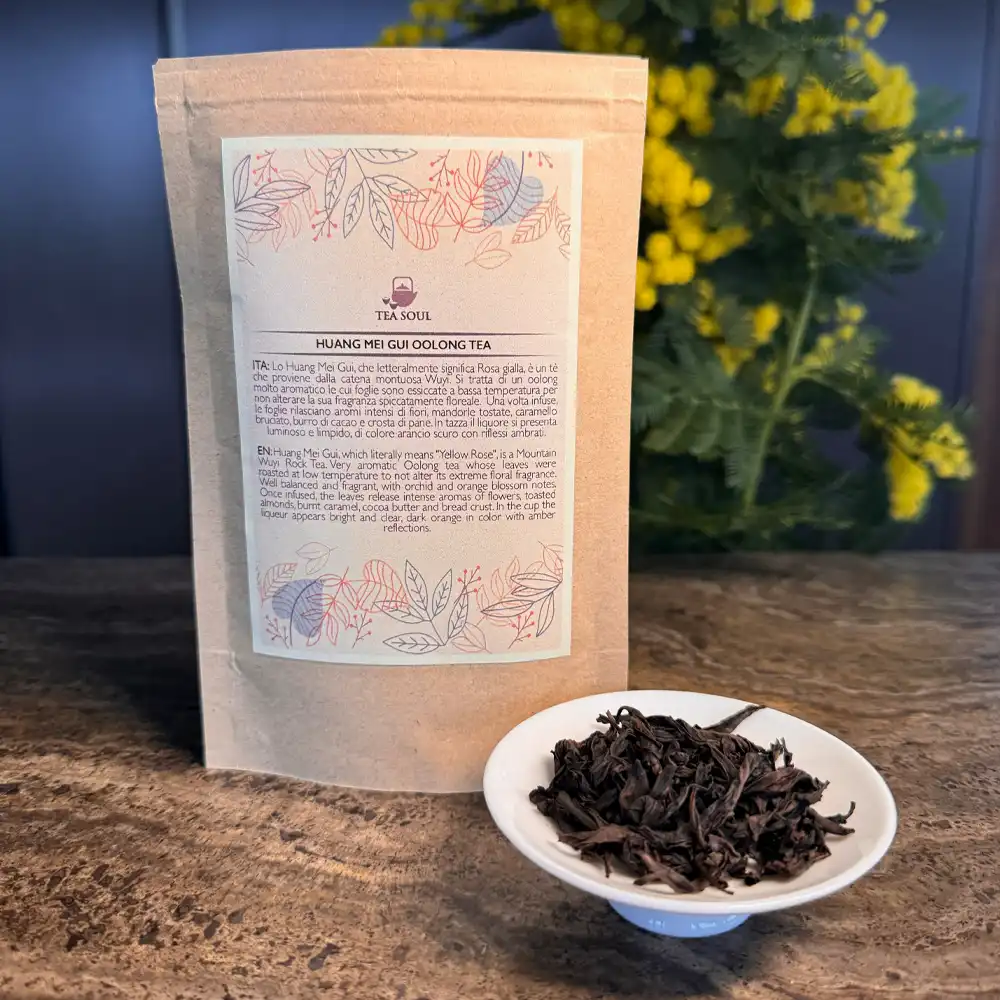
Huang Mei Gui is a rock oolong whose name can be translated as “yellow rose”. This name originated relatively recently, as this product only began being produced in 2002. Before this date, the cultivar of this tea was perfected and grown on the rocky soil of the Wuyi Mountains, where it is now produced alongside other more famous varieties such as Shui Jing Gui, Tie Luo Han, Shui Xian, etc. This product’s aromatic and floral characteristics stand out considerably compared with other yancha, also thanks to a lower-than-average oxidation level. The roasting is also often carried out more lightly, resulting in a slightly acidic flavor which, together with the floral notes, settles on the palate and leaves a very rich aftertaste. Obviously, throughout the tasting, the mineral effect provided by the soil can be clearly perceived, giving the tea a very smooth body and also increasing the persistence of the flavors described above. We invite you to infuse this tea using the gong fu cha method to fully appreciate the complexity and interactions these flavors can express on the palate. Tasting: appearance and aroma Huang Mei Gui oolong tea has medium-to-large whole leaves, rolled in shape and brown in color, with chestnut nuances and mahogany highlights. Once infused, the leaves release intense aromas of flowers, toasted almonds, burnt caramel, cocoa butter and bread crust. In the cup, the liquor is bright and clear, dark orange in color with amber highlights. Tasting notes: gong fu cha The first infusion of Huang Mei Gui oolong tea has pronounced floral notes of orchid, sweet scents of cane sugar and a fruity finish reminiscent of the tropics, with notes of coconut and fresh pineapple. With the second infusion, the intensity of the floral notes increases, joined by orange blossom and monoi. A citrus note also appears on the sides of the tongue, amplifying the sensation of freshness provided by the flowers. Soft, sweet scents of coconut butter and dark bread complete the profile. With the third infusion, the acidic note disappears, giving way to sweet and enveloping scents of cocoa and toasted nuts, such as almonds and hazelnuts. The tea remains distinctly floral, with delicate notes of vanilla sugar and a hint of coconut on the finish. Western-style preparation The first sip of Huang Mei Gui oolong tea envelops the palate with the smoothness and sweetness of cocoa and toasted nuts. Immediately afterward, floral notes emerge, with intense aromas of orchid and water flowers and exotic monoi notes. The palate evolves toward tropical scents, with fruity notes such as coconut, pineapple and kiwi and a very slight acidic note on the sides of the tongue. On the finish, notes of dark bread crust and caramel emerge, while the floral and slightly vanilla-like scents linger for a long time. The tea has a medium body and is completely free of bitterness, with barely detectable astringency. Place of origin: Wuyi Shan, Fujian - China Production After harvesting, Huang Mei Gui leaves are wilted in the sun for a certain period of time before resting on covered bamboo trays. Oxidation is then initiated by manually massaging the leaves, carried out by the producing master. Once the tea reaches the desired oxidation level (approximately 45% oxidation here), the leaves are placed in a charcoal-heated oven, where enzymatic activity is halted. After this oven stage, the leaves are given their final shape using a special machine before undergoing roasting cycles, which finish drying the product and enhance its flavors. Preparation We strongly recommend infusing Huang Mei Gui tea using the traditional Chinese method (gong fu cha) to enjoy these leaves at their best. With this preparation, use 6 grams of leaves (about 4 teaspoons) in a gaiwan of approximately 100 ml to obtain multiple infusions with different flavors. After quickly rinsing the leaves in water at 100 °C, proceed with a first infusion of 10 seconds. Then, keeping the water at the same temperature, increase the time by 5 seconds each time compared with the previous infusion (10 – 15 – 20 …). This tea can yield approximately 7 infusions. For a classic Western-style preparation, we recommend 3 grams of leaves (about 2 teaspoons) in a 150 ml cup, with water at 100 °C, for an infusion time of one and a half minutes. The tea may be filtered for easier tasting, and the infusion times indicated above are purely suggestions; they can also be adjusted according to personal taste. Store in a cool, dry place away from direct sunlight.
Price including VAT
Huang Mei Gui is a rock oolong whose name can be translated as “yellow rose”. This name originated relatively recently, as this product only began being produced in 2002. Before this date, the cultivar of this tea was perfected and grown on the rocky soil of the Wuyi Mountains, where it is now produced alongside other more famous varieties such as Shui Jing Gui, Tie Luo Han, Shui Xian, etc. This product’s aromatic and floral characteristics stand out considerably compared with other yancha, also thanks to a lower-than-average oxidation level. The roasting is also often carried out more lightly, resulting in a slightly acidic flavor which, together with the floral notes, settles on the palate and leaves a very rich aftertaste. Obviously, throughout the tasting, the mineral effect provided by the soil can be clearly perceived, giving the tea a very smooth body and also increasing the persistence of the flavors described above. We invite you to infuse this tea using the gong fu cha method to fully appreciate the complexity and interactions these flavors can express on the palate. Tasting: appearance and aroma Huang Mei Gui oolong tea has medium-to-large whole leaves, rolled in shape and brown in color, with chestnut nuances and mahogany highlights. Once infused, the leaves release intense aromas of flowers, toasted almonds, burnt caramel, cocoa butter and bread crust. In the cup, the liquor is bright and clear, dark orange in color with amber highlights. Tasting notes: gong fu cha The first infusion of Huang Mei Gui oolong tea has pronounced floral notes of orchid, sweet scents of cane sugar and a fruity finish reminiscent of the tropics, with notes of coconut and fresh pineapple. With the second infusion, the intensity of the floral notes increases, joined by orange blossom and monoi. A citrus note also appears on the sides of the tongue, amplifying the sensation of freshness provided by the flowers. Soft, sweet scents of coconut butter and dark bread complete the profile. With the third infusion, the acidic note disappears, giving way to sweet and enveloping scents of cocoa and toasted nuts, such as almonds and hazelnuts. The tea remains distinctly floral, with delicate notes of vanilla sugar and a hint of coconut on the finish. Western-style preparation The first sip of Huang Mei Gui oolong tea envelops the palate with the smoothness and sweetness of cocoa and toasted nuts. Immediately afterward, floral notes emerge, with intense aromas of orchid and water flowers and exotic monoi notes. The palate evolves toward tropical scents, with fruity notes such as coconut, pineapple and kiwi and a very slight acidic note on the sides of the tongue. On the finish, notes of dark bread crust and caramel emerge, while the floral and slightly vanilla-like scents linger for a long time. The tea has a medium body and is completely free of bitterness, with barely detectable astringency. Place of origin: Wuyi Shan, Fujian - China Production After harvesting, Huang Mei Gui leaves are wilted in the sun for a certain period of time before resting on covered bamboo trays. Oxidation is then initiated by manually massaging the leaves, carried out by the producing master. Once the tea reaches the desired oxidation level (approximately 45% oxidation here), the leaves are placed in a charcoal-heated oven, where enzymatic activity is halted. After this oven stage, the leaves are given their final shape using a special machine before undergoing roasting cycles, which finish drying the product and enhance its flavors. Preparation We strongly recommend infusing Huang Mei Gui tea using the traditional Chinese method (gong fu cha) to enjoy these leaves at their best. With this preparation, use 6 grams of leaves (about 4 teaspoons) in a gaiwan of approximately 100 ml to obtain multiple infusions with different flavors. After quickly rinsing the leaves in water at 100 °C, proceed with a first infusion of 10 seconds. Then, keeping the water at the same temperature, increase the time by 5 seconds each time compared with the previous infusion (10 – 15 – 20 …). This tea can yield approximately 7 infusions. For a classic Western-style preparation, we recommend 3 grams of leaves (about 2 teaspoons) in a 150 ml cup, with water at 100 °C, for an infusion time of one and a half minutes. The tea may be filtered for easier tasting, and the infusion times indicated above are purely suggestions; they can also be adjusted according to personal taste. Store in a cool, dry place away from direct sunlight.