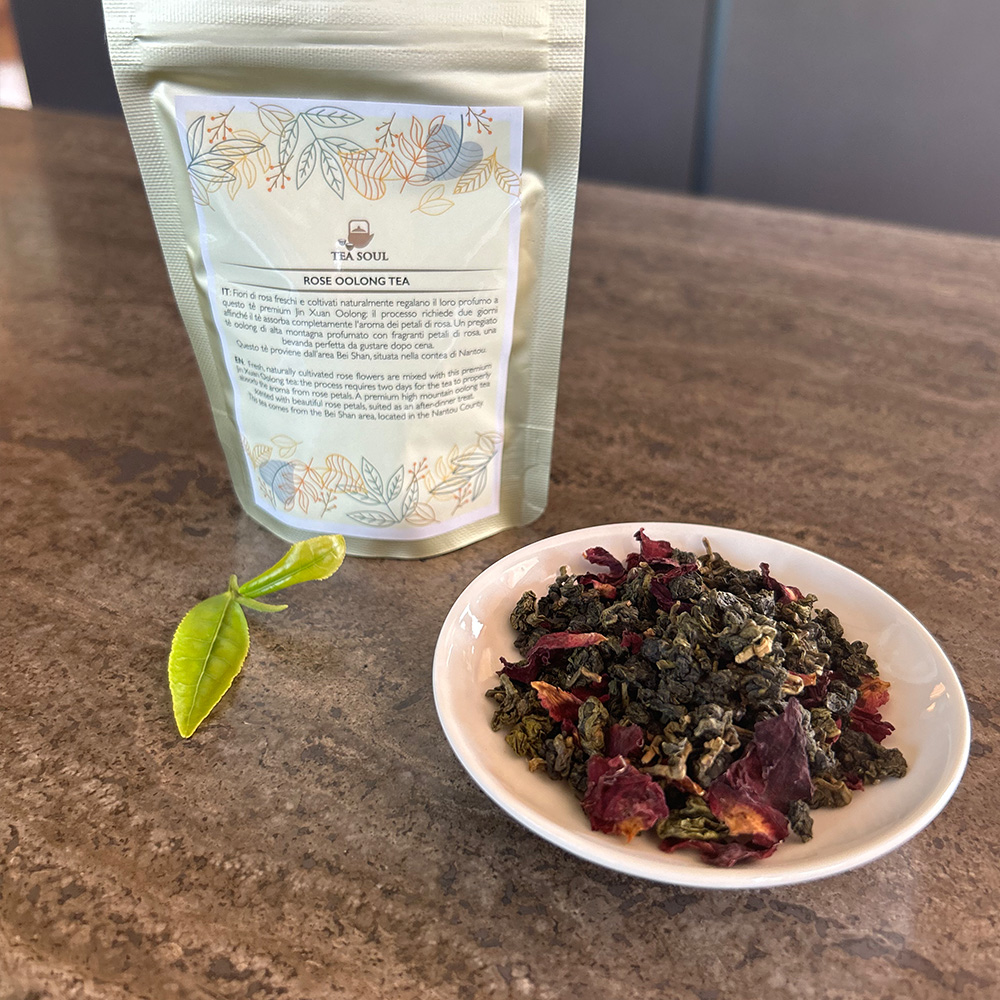
Fresh and naturally cultivated rose flowers give their fragrance to this Oolong Rose Tea. The process takes two days for the tea to absorb the aroma of the rose petals completely through contact. It is a fine high mountain oolong tea that proves to be a perfect drink to savor even after dinner, hot or infused cold to refresh with taste in the summer period. The leaves of Oolong Rose tea are tightly rolled, narrow, and small, with a glossy surface and colors ranging from bright green to dark green with some yellow-ochre shades, especially near the stems. Along with the leaves, dark magenta rose petal fragments can be noticed, creating a beautiful color contrast. Once infused, the leaves release floral aromas of damask rose and notes reminiscent of glutinous rice, with a slight vegetal note and a distinct sweetness that evokes powdered sugar. The liquor in the cup is golden, clear, and bright. The first infusion of Oolong Rose tea has subtle notes of rose and roasted notes of dried fruit and cereal starch. A delicate sweetness is also perceived, reminiscent of acacia honey. With the second infusion, the flavors become more intense: the taste of the rose is now more pronounced without ever becoming pungent. The sugary notes significantly increase, lingering in the back of the throat, as do the stronger notes of nuts, particularly almond and cashew. With the third infusion and subsequent ones, the rose becomes more delicate again, while the roasted nut note enhances, and the starchy and sweet component reappears to envelop the palate. At the start, Oolong Rose tea features a very gentle floral note of rose, followed by aromas of acacia honey and finishing with nut flavors, along with the intense sweetness of praline almonds. The body is medium, very silky on the palate, with a complete absence of astringency or bitterness. The aftertaste is sweet and floral, with pleasant notes of rose and almond. The tea comes from Bei Shan, located in Nantou County, Taiwan. We strongly recommend infusing Oolong Rose Tea using the traditional Chinese method (Gong Fu Cha) with a gaiwan of about 150 ml capacity. Following this preparation, with 5 grams of leaves, multiple infusions can be made to best capture all the nuances of flavor in the tea. After a quick rinse with water at a temperature of 85°C, proceed with a first infusion of 30 seconds. By keeping the water at the same temperature, you can continue to use the same leaves by adding more water and increasing the infusion time by 10 seconds each time (30-40-50…). This tea has a longevity of 5-6 infusions. For a more classic preparation in the Western style, we recommend 3 grams of leaves (about 2 teaspoons) in a 200 ml cup with water at 85°C for an infusion time of 3 minutes. For a better tasting experience, we suggest straining the infusion immediately after the infusion time is complete. The infusion times can also be slightly adjusted to personal preference for a more or less intense taste. It is advised to store in a cool, dry place away from direct sunlight. The main benefits that can be derived from Oolong teas come from the significant content of minerals and antioxidant phenols present in the leaves. Some studies report that daily intake of Oolong can positively affect bone health by improving mineral concentration in this tissue and promoting a decrease in blood sugar levels due to the stimulating effect of phenols on insulin. Oolong teas also generally have a low caffeine concentration, making them suitable for consumption at any time of the day, even by those most sensitive to this substance.
Price VAT included







Fresh and naturally cultivated rose flowers give their fragrance to this Oolong Rose Tea. The process takes two days for the tea to absorb the aroma of the rose petals completely through contact. It is a fine high mountain oolong tea that proves to be a perfect drink to savor even after dinner, hot or infused cold to refresh with taste in the summer period. The leaves of Oolong Rose tea are tightly rolled, narrow, and small, with a glossy surface and colors ranging from bright green to dark green with some yellow-ochre shades, especially near the stems. Along with the leaves, dark magenta rose petal fragments can be noticed, creating a beautiful color contrast. Once infused, the leaves release floral aromas of damask rose and notes reminiscent of glutinous rice, with a slight vegetal note and a distinct sweetness that evokes powdered sugar. The liquor in the cup is golden, clear, and bright. The first infusion of Oolong Rose tea has subtle notes of rose and roasted notes of dried fruit and cereal starch. A delicate sweetness is also perceived, reminiscent of acacia honey. With the second infusion, the flavors become more intense: the taste of the rose is now more pronounced without ever becoming pungent. The sugary notes significantly increase, lingering in the back of the throat, as do the stronger notes of nuts, particularly almond and cashew. With the third infusion and subsequent ones, the rose becomes more delicate again, while the roasted nut note enhances, and the starchy and sweet component reappears to envelop the palate. At the start, Oolong Rose tea features a very gentle floral note of rose, followed by aromas of acacia honey and finishing with nut flavors, along with the intense sweetness of praline almonds. The body is medium, very silky on the palate, with a complete absence of astringency or bitterness. The aftertaste is sweet and floral, with pleasant notes of rose and almond. The tea comes from Bei Shan, located in Nantou County, Taiwan. We strongly recommend infusing Oolong Rose Tea using the traditional Chinese method (Gong Fu Cha) with a gaiwan of about 150 ml capacity. Following this preparation, with 5 grams of leaves, multiple infusions can be made to best capture all the nuances of flavor in the tea. After a quick rinse with water at a temperature of 85°C, proceed with a first infusion of 30 seconds. By keeping the water at the same temperature, you can continue to use the same leaves by adding more water and increasing the infusion time by 10 seconds each time (30-40-50…). This tea has a longevity of 5-6 infusions. For a more classic preparation in the Western style, we recommend 3 grams of leaves (about 2 teaspoons) in a 200 ml cup with water at 85°C for an infusion time of 3 minutes. For a better tasting experience, we suggest straining the infusion immediately after the infusion time is complete. The infusion times can also be slightly adjusted to personal preference for a more or less intense taste. It is advised to store in a cool, dry place away from direct sunlight. The main benefits that can be derived from Oolong teas come from the significant content of minerals and antioxidant phenols present in the leaves. Some studies report that daily intake of Oolong can positively affect bone health by improving mineral concentration in this tissue and promoting a decrease in blood sugar levels due to the stimulating effect of phenols on insulin. Oolong teas also generally have a low caffeine concentration, making them suitable for consumption at any time of the day, even by those most sensitive to this substance.