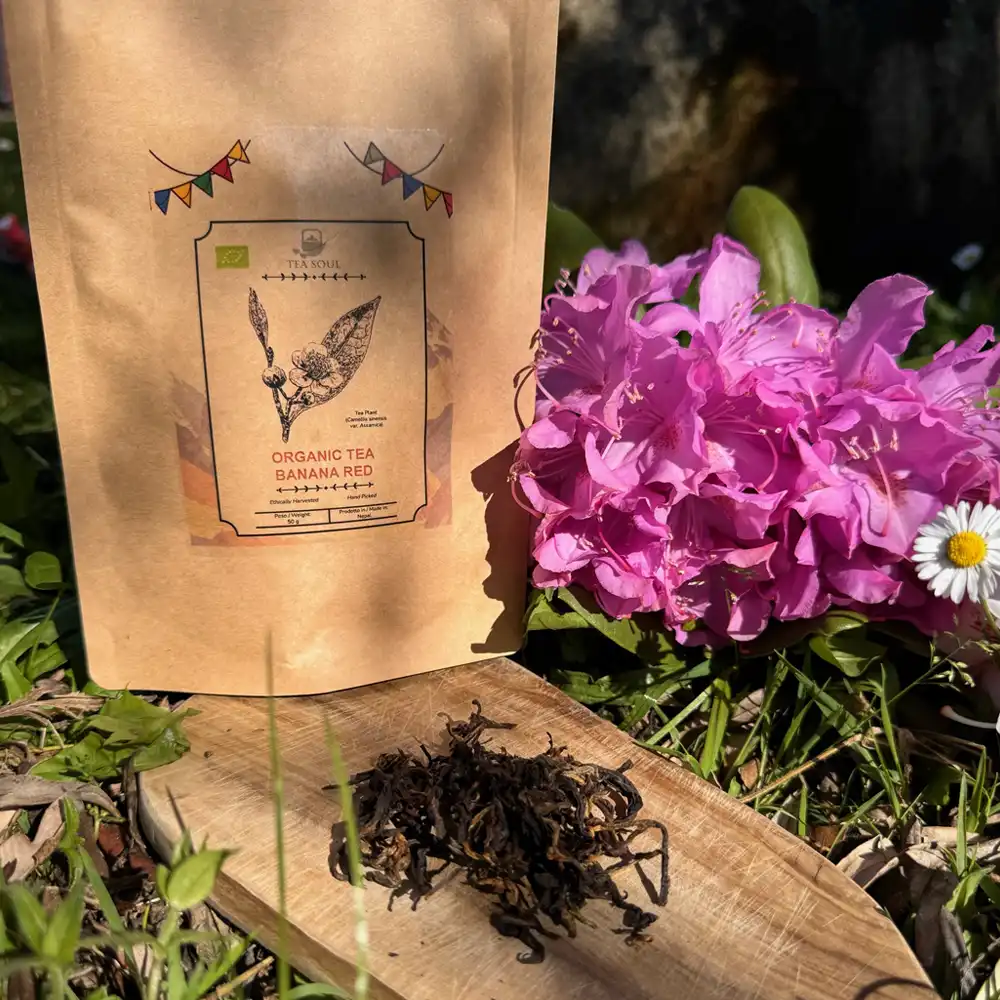
This banana red tea from Nepal, in addition to coming from a region still little known in the West and being grown and produced at high altitude, also has the special characteristic of being oxidized wrapped in banana leaves. The processing of the camellia leaves consists in wrapping them in banana leaves while the enzymes oxidize, creating larger compounds that give the leaves their characteristic brown color and tannic flavor. This experimental technique has the result of slightly lowering the temperature at which certain oxidation reactions occur, best preserving some of the sweeter and more aromatic flavors of this product. In addition to oxidation, thanks to the protection provided by the banana leaves, the tea also undergoes a quick roasting that further develops the sweetness of the product and reduces the impact of tannins. When tasting the tea, in fact, the first notes perceived will be fruity, accompanied by a slight toasted cocoa note. Subsequently, in the aftertaste, you can notice how these two elements merge, creating a creamy sensation that can recall the full-bodied sweetness of banana. Place of origin Taplejung, Nepal. Production. After harvest, the leaves are left to wither in the sun for a certain period, depending on the producer, before moving on to the rolling stage. The leaves are then folded and rolled so that the juices inside mix together and the oxidation process can begin. Afterwards, the leaves are fermented in banana leaves for 20 hours. Once the leaves reach their typical brown color, the remaining internal moisture is removed and, after a few days of resting, the tea is ready to be consumed. Preparation. We strongly recommend brewing this tea according to the traditional Chinese method (gong fu cha) to best appreciate these leaves. Following this preparation, 5.5 grams of leaves can be used in a gaiwan of about 100 ml to obtain several infusions with different flavors. After a quick rinse of the leaves in water at 100°C, you can proceed with a first infusion of 15 seconds and, keeping the water at the same temperature, continue increasing the time by 10 seconds each time compared to the previous infusion. This tea has a longevity of about 5 infusions. For a classic western-style preparation, we recommend 3 grams of leaves in a 150 ml cup with water at 100°C for an infusion time of one and a half minutes. The tea can be filtered for easier tasting, and the infusion times indicated above are purely approximate, so they can also be adjusted according to personal taste. It is recommended to store the tea in a cool, dry place away from direct sunlight.
Price VAT included
This banana red tea from Nepal, in addition to coming from a region still little known in the West and being grown and produced at high altitude, also has the special characteristic of being oxidized wrapped in banana leaves. The processing of the camellia leaves consists in wrapping them in banana leaves while the enzymes oxidize, creating larger compounds that give the leaves their characteristic brown color and tannic flavor. This experimental technique has the result of slightly lowering the temperature at which certain oxidation reactions occur, best preserving some of the sweeter and more aromatic flavors of this product. In addition to oxidation, thanks to the protection provided by the banana leaves, the tea also undergoes a quick roasting that further develops the sweetness of the product and reduces the impact of tannins. When tasting the tea, in fact, the first notes perceived will be fruity, accompanied by a slight toasted cocoa note. Subsequently, in the aftertaste, you can notice how these two elements merge, creating a creamy sensation that can recall the full-bodied sweetness of banana. Place of origin Taplejung, Nepal. Production. After harvest, the leaves are left to wither in the sun for a certain period, depending on the producer, before moving on to the rolling stage. The leaves are then folded and rolled so that the juices inside mix together and the oxidation process can begin. Afterwards, the leaves are fermented in banana leaves for 20 hours. Once the leaves reach their typical brown color, the remaining internal moisture is removed and, after a few days of resting, the tea is ready to be consumed. Preparation. We strongly recommend brewing this tea according to the traditional Chinese method (gong fu cha) to best appreciate these leaves. Following this preparation, 5.5 grams of leaves can be used in a gaiwan of about 100 ml to obtain several infusions with different flavors. After a quick rinse of the leaves in water at 100°C, you can proceed with a first infusion of 15 seconds and, keeping the water at the same temperature, continue increasing the time by 10 seconds each time compared to the previous infusion. This tea has a longevity of about 5 infusions. For a classic western-style preparation, we recommend 3 grams of leaves in a 150 ml cup with water at 100°C for an infusion time of one and a half minutes. The tea can be filtered for easier tasting, and the infusion times indicated above are purely approximate, so they can also be adjusted according to personal taste. It is recommended to store the tea in a cool, dry place away from direct sunlight.
Every product available on the marketplace is listed and sold by a partner seller indicated on the product page. The platform acts as a metasearch/marketplace: it facilitates discovery and checkout, but the sale is carried out by the seller, who becomes the party responsible for the transaction.
Shipping is handled directly by the seller partner. The package leaves the seller's warehouse, or its logistics network, and is handed over to the carrier. This model enables more efficient deliveries and ensures that order management is handled by those who actually have the product available.
On the product page you will find ingredients, allergens and nutritional information according to the data provided by the seller or manufacturer, i.e. the official label. If you have allergies or intolerances, we recommend that you carefully check the product page before purchasing and contact the seller with any specific questions.
The platform was created to promote and make Italian food Made in Italy more accessible. We select e-commerce food sellers with coherent catalogs and transparent information. Each product is linked to an identifiable seller and a complete information sheet: we want buying here to mean buying with confidence.
Delivery times and costs depend on the seller and the destination. At checkout you will always find the current delivery estimate before confirming payment. For international shipments, times may vary depending on the country and the carrier.