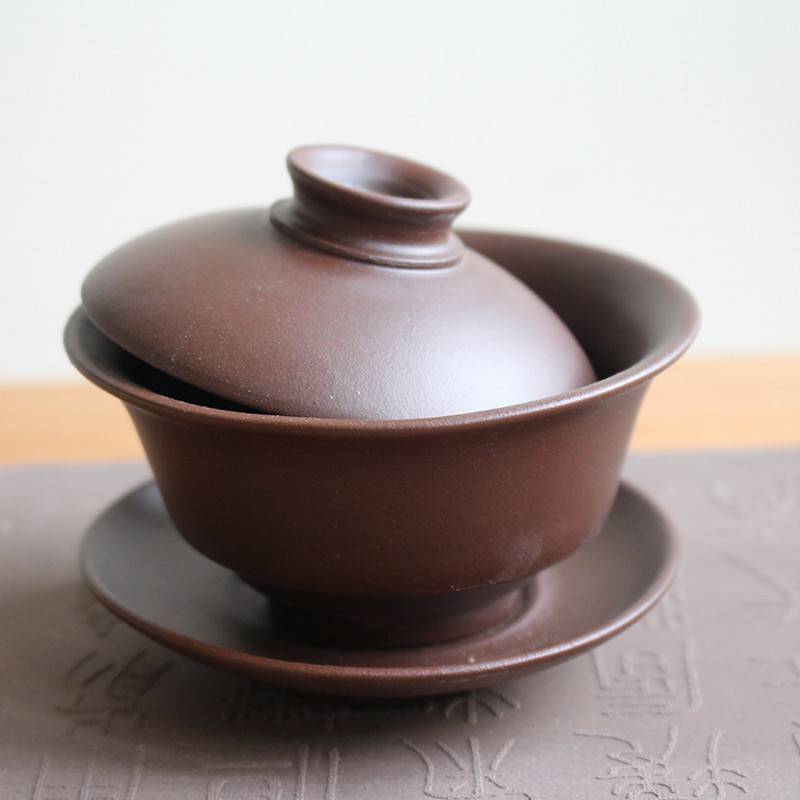
The Yixing clay Gaiwan in traditional Chinese style is made from the famous Chinese purple clay, called Zi Sha Hu in China. This type of clay is the most famous in China and its accessories have been used in the tea ceremony for a very long time. They are so called because of a small town located in Jiangsu province, where a specific iron-mineral compound causes the unique coloring of these accessories. They were fired without glaze and used to prepare specific types of tea. Because of the porous nature of the clay, the Gaiwan should be gradually seasoned by using it to steep one type of tea. Yixing Gaiwans are meant to be used with black (red) teas and Oolong, as well as aged Puer tea. They can also be used for green or white tea, but the water must be cooled to about 85°C before pouring it into the vessel. Yixing Gaiwans absorb a small amount of tea inside during preparation. After prolonged use, the Gaiwan will develop a layer that preserves the flavor and color of the tea. For this reason, soap must not be used to clean Yixing Gaiwans. Instead, they should be rinsed with fresh water and left to air dry.
Price VAT included
The Yixing clay Gaiwan in traditional Chinese style is made from the famous Chinese purple clay, called Zi Sha Hu in China. This type of clay is the most famous in China and its accessories have been used in the tea ceremony for a very long time. They are so called because of a small town located in Jiangsu province, where a specific iron-mineral compound causes the unique coloring of these accessories. They were fired without glaze and used to prepare specific types of tea. Because of the porous nature of the clay, the Gaiwan should be gradually seasoned by using it to steep one type of tea. Yixing Gaiwans are meant to be used with black (red) teas and Oolong, as well as aged Puer tea. They can also be used for green or white tea, but the water must be cooled to about 85°C before pouring it into the vessel. Yixing Gaiwans absorb a small amount of tea inside during preparation. After prolonged use, the Gaiwan will develop a layer that preserves the flavor and color of the tea. For this reason, soap must not be used to clean Yixing Gaiwans. Instead, they should be rinsed with fresh water and left to air dry.
Every product available on the marketplace is listed and sold by a partner seller indicated on the product page. The platform acts as a metasearch/marketplace: it facilitates discovery and checkout, but the sale is carried out by the seller, who becomes the party responsible for the transaction.
Shipping is handled directly by the seller partner. The package leaves the seller's warehouse, or its logistics network, and is handed over to the carrier. This model enables more efficient deliveries and ensures that order management is handled by those who actually have the product available.
On the product page you will find ingredients, allergens and nutritional information according to the data provided by the seller or manufacturer, i.e. the official label. If you have allergies or intolerances, we recommend that you carefully check the product page before purchasing and contact the seller with any specific questions.
The platform was created to promote and make Italian food Made in Italy more accessible. We select e-commerce food sellers with coherent catalogs and transparent information. Each product is linked to an identifiable seller and a complete information sheet: we want buying here to mean buying with confidence.
Delivery times and costs depend on the seller and the destination. At checkout you will always find the current delivery estimate before confirming payment. For international shipments, times may vary depending on the country and the carrier.