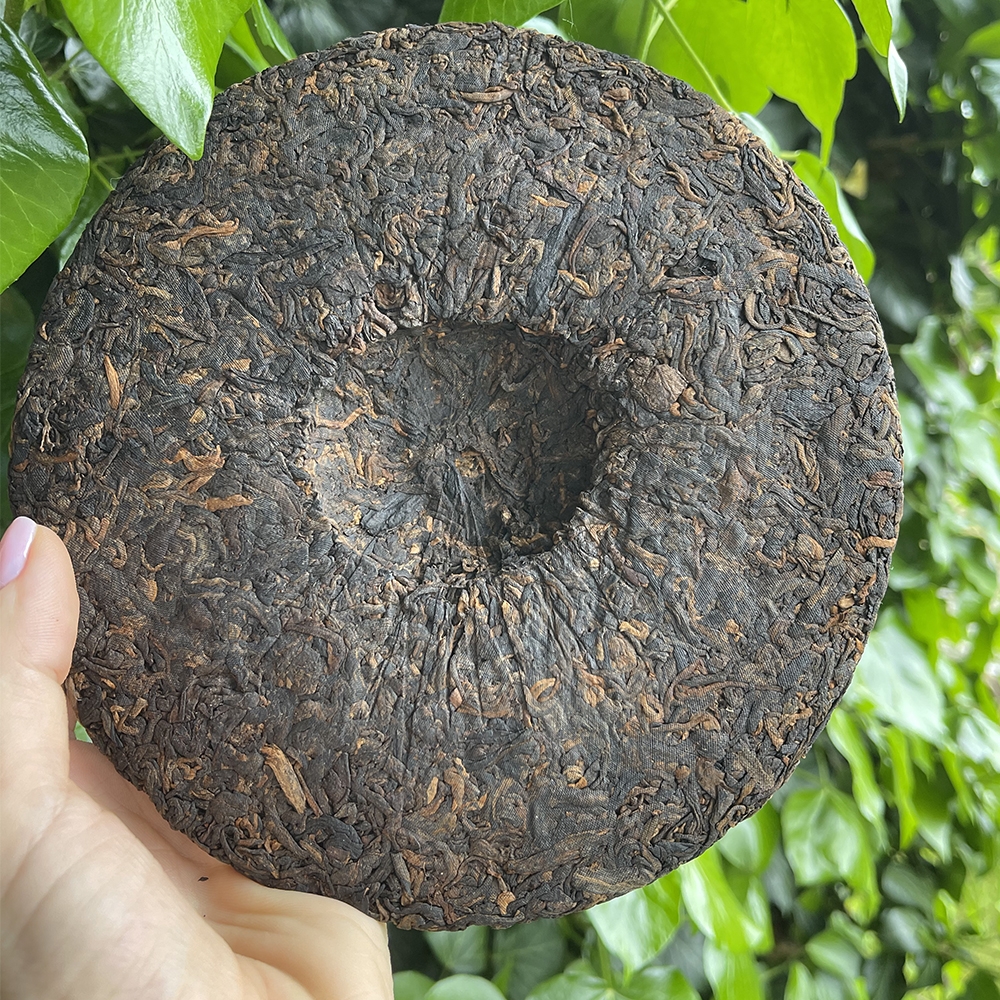
The Tè Puer Shu (cooked) Growing Aroma 2019 is a carefully selected product from Tea Soul to offer a tasting and knowledge experience even more in-depth regarding the complex category of puer teas. The gardens from which the leaves of this shu come are located near the city of Mengzhe in the Menghai County. From this area in the far south of Yunnan, in the province of Xishuangbanna, many high-quality puer teas come thanks to the excellent raw material of the region and the great presence of skilled and experienced tea artisans. The infusion of the Tè Puer Shu (cooked) Growing Aroma 2019 is able, through its flavors, to demonstrate the extreme care and knowledge of the fermentation techniques by the tea masters in the Menghai area. From the very beginning, in fact, the taste of the tea is very clean and free of any moisture residue due to the processing. On the palate, the fermented aspect of this puer presents with balsamic and woody flavors, which in the aftertaste leave a distinct mineral trace. During the tasting, in addition to the characteristic flavors of this category of tea, a sweet taste similar to that in some herbal liqueurs can be felt alongside a fragrant scent reminiscent of freshly baked bread. The body of the infusion, finally, is very balanced on the palate, giving both a good sensation of softness and a slight balsamic dryness. To discover a fermentation style with a more pronounced presence in the infusion, still from the Menghai area, we suggest trying the Tè Puer Shu (cooked) Menghai Chen Xiang 2019. Origin: Mengzhe, Menghai County - Yunnan, China. After harvesting, the leaves of the Tè Puer Shu (cooked) Growing Aroma 2019 are left to wilt in the sun for a certain period depending on the producer, before moving to the "killing the green" phase, which is very similar to that used to produce green teas. The peculiarity, in this case, lies in not heating the leaves as much as is done for green tea, so that some enzymes capable of changing flavors over time are preserved. Once cooked, the leaves are taken in large quantities and stacked to form large mounds. The plant mass thus arranged is then moistened and covered with cloths so that heat can be retained and the fermentation process can start. Here, the producer must skillfully move the leaves and slightly moisten them as they proceed so that fermentation advances steadily and distributes as evenly as possible. Once this processing is complete, which can last from 20 to 70 days, the leaves are spread out and left in contact with the air so that the microorganisms responsible for fermentation dry out and die, leaving the finished product. Once this point is reached, one can (optionally) proceed to press the puer in order to give it the best conditions for transport and aging. To press the leaves, they are passed for a few seconds through a strong jet of steam, to make them soft externally, and are then collected in a stocking or bag that will give the shape, usually disc-shaped, to the product. To ensure that such a structure remains stable over time, the bag is left for hours under a stone or mechanical press while the leaves lose that residual moisture taken from steam in the previous phase. We highly recommend infusing the Tè Puer Shu (cooked) Growing Aroma 2019 using the traditional Chinese method (Gong Fu Cha) with a Gaiwan holding about 100 ml. Following this preparation, with 5.5 grams of leaves, multiple infusions can be made to best appreciate all the flavors of the tea. After a quick rinse of the leaves with water at a temperature of 100°C, one can proceed to a first infusion of 10 seconds and, subsequently, keeping the water at the same temperature, continue to utilize the product, adding more water and increasing the previous infusion time by about 10 seconds (10 - 20 - 30…). For a more traditional preparation according to Western style, we recommend 3 grams of leaves (about 2 teaspoons) in a 150 ml cup with water at 100°C for an infusion time of one and a half minutes. For a better tasting experience, we suggest filtering the infusion as soon as the established maceration time is over. The infusion times we suggest can also be slightly modified at your leisure to achieve a more or less intense flavor. It is advisable to store in a cool, dry place away from direct sunlight. Tè Puer Shu (cooked) show significant benefits for the digestive system, due to the richness of microorganisms formed on the leaves during the fermentation process. A daily intake of this tea particularly promotes greater digestive regularity and enriches intestinal flora. Puer Shu, besides improving digestion, provides the body with a good amount of minerals and some antioxidants useful for maintaining good oxygenation of the blood and, consequently, better circulation. Unlike Puer Sheng, this fermented variant presents lower levels of caffeine, thus becoming more tolerable even for people sensitive to the famous stimulating molecule. The stimulation of the nervous system given by the infusion of Puer Shu tends rather to favor a pleasant sensation of muscle relaxation.
Price VAT included
The Tè Puer Shu (cooked) Growing Aroma 2019 is a carefully selected product from Tea Soul to offer a tasting and knowledge experience even more in-depth regarding the complex category of puer teas. The gardens from which the leaves of this shu come are located near the city of Mengzhe in the Menghai County. From this area in the far south of Yunnan, in the province of Xishuangbanna, many high-quality puer teas come thanks to the excellent raw material of the region and the great presence of skilled and experienced tea artisans. The infusion of the Tè Puer Shu (cooked) Growing Aroma 2019 is able, through its flavors, to demonstrate the extreme care and knowledge of the fermentation techniques by the tea masters in the Menghai area. From the very beginning, in fact, the taste of the tea is very clean and free of any moisture residue due to the processing. On the palate, the fermented aspect of this puer presents with balsamic and woody flavors, which in the aftertaste leave a distinct mineral trace. During the tasting, in addition to the characteristic flavors of this category of tea, a sweet taste similar to that in some herbal liqueurs can be felt alongside a fragrant scent reminiscent of freshly baked bread. The body of the infusion, finally, is very balanced on the palate, giving both a good sensation of softness and a slight balsamic dryness. To discover a fermentation style with a more pronounced presence in the infusion, still from the Menghai area, we suggest trying the Tè Puer Shu (cooked) Menghai Chen Xiang 2019. Origin: Mengzhe, Menghai County - Yunnan, China. After harvesting, the leaves of the Tè Puer Shu (cooked) Growing Aroma 2019 are left to wilt in the sun for a certain period depending on the producer, before moving to the "killing the green" phase, which is very similar to that used to produce green teas. The peculiarity, in this case, lies in not heating the leaves as much as is done for green tea, so that some enzymes capable of changing flavors over time are preserved. Once cooked, the leaves are taken in large quantities and stacked to form large mounds. The plant mass thus arranged is then moistened and covered with cloths so that heat can be retained and the fermentation process can start. Here, the producer must skillfully move the leaves and slightly moisten them as they proceed so that fermentation advances steadily and distributes as evenly as possible. Once this processing is complete, which can last from 20 to 70 days, the leaves are spread out and left in contact with the air so that the microorganisms responsible for fermentation dry out and die, leaving the finished product. Once this point is reached, one can (optionally) proceed to press the puer in order to give it the best conditions for transport and aging. To press the leaves, they are passed for a few seconds through a strong jet of steam, to make them soft externally, and are then collected in a stocking or bag that will give the shape, usually disc-shaped, to the product. To ensure that such a structure remains stable over time, the bag is left for hours under a stone or mechanical press while the leaves lose that residual moisture taken from steam in the previous phase. We highly recommend infusing the Tè Puer Shu (cooked) Growing Aroma 2019 using the traditional Chinese method (Gong Fu Cha) with a Gaiwan holding about 100 ml. Following this preparation, with 5.5 grams of leaves, multiple infusions can be made to best appreciate all the flavors of the tea. After a quick rinse of the leaves with water at a temperature of 100°C, one can proceed to a first infusion of 10 seconds and, subsequently, keeping the water at the same temperature, continue to utilize the product, adding more water and increasing the previous infusion time by about 10 seconds (10 - 20 - 30…). For a more traditional preparation according to Western style, we recommend 3 grams of leaves (about 2 teaspoons) in a 150 ml cup with water at 100°C for an infusion time of one and a half minutes. For a better tasting experience, we suggest filtering the infusion as soon as the established maceration time is over. The infusion times we suggest can also be slightly modified at your leisure to achieve a more or less intense flavor. It is advisable to store in a cool, dry place away from direct sunlight. Tè Puer Shu (cooked) show significant benefits for the digestive system, due to the richness of microorganisms formed on the leaves during the fermentation process. A daily intake of this tea particularly promotes greater digestive regularity and enriches intestinal flora. Puer Shu, besides improving digestion, provides the body with a good amount of minerals and some antioxidants useful for maintaining good oxygenation of the blood and, consequently, better circulation. Unlike Puer Sheng, this fermented variant presents lower levels of caffeine, thus becoming more tolerable even for people sensitive to the famous stimulating molecule. The stimulation of the nervous system given by the infusion of Puer Shu tends rather to favor a pleasant sensation of muscle relaxation.