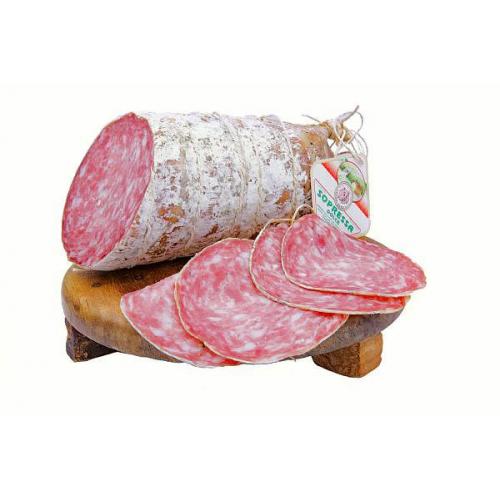
The Classic Veneta Sopressa (on this page without garlic) from the Salumificio Freoni Danzi is a cured product of pure Italian pork, stuffed into a natural casing and manually tied with twine. Its high quality is recognized by its firmness to the touch which, combined with tenderness when sliced, allows it to melt in the mouth. The venetian salami shouldn’t present a high hardness when cut and tasted, but should be pleasant and delicate to ensure an intense perception of cured flavor, savory but not salty. There are several testimonies that demonstrate the ancient origin of Sopressa, a cornerstone of venetian culinary tradition. The most important is undoubtedly the one dating back to 1577, when the painter Jacopo da Bassano created the painting "Christ in the House of Martha, Mary, and Lazarus" where Lazarus is depicted cutting a cured meat very similar to a Sopressa. The venetian Sopressa has a single 'p' in its name to distinguish it from other soppresse, typical of Southern Italy. It is made from the noble parts of the pig that are traditionally worked separately: coppa, shoulder, pancetta, loin, and thigh. Every venetian province has its own Sopressa, whose origins appear to be in the Vicenza area and the differences between the various provincial productions lie in the different use of wine in the mixture. The secret behind a quality Sopressa is the ability to stuff without leaving air pockets; the craftsmen of the past did it by hand, whereas today, machines are used which ensure a uniform stuffing.
Shipping costs £40.16, free over £249.40
Price VAT included







The Classic Veneta Sopressa (on this page without garlic) from the Salumificio Freoni Danzi is a cured product of pure Italian pork, stuffed into a natural casing and manually tied with twine. Its high quality is recognized by its firmness to the touch which, combined with tenderness when sliced, allows it to melt in the mouth. The venetian salami shouldn’t present a high hardness when cut and tasted, but should be pleasant and delicate to ensure an intense perception of cured flavor, savory but not salty. There are several testimonies that demonstrate the ancient origin of Sopressa, a cornerstone of venetian culinary tradition. The most important is undoubtedly the one dating back to 1577, when the painter Jacopo da Bassano created the painting "Christ in the House of Martha, Mary, and Lazarus" where Lazarus is depicted cutting a cured meat very similar to a Sopressa. The venetian Sopressa has a single 'p' in its name to distinguish it from other soppresse, typical of Southern Italy. It is made from the noble parts of the pig that are traditionally worked separately: coppa, shoulder, pancetta, loin, and thigh. Every venetian province has its own Sopressa, whose origins appear to be in the Vicenza area and the differences between the various provincial productions lie in the different use of wine in the mixture. The secret behind a quality Sopressa is the ability to stuff without leaving air pockets; the craftsmen of the past did it by hand, whereas today, machines are used which ensure a uniform stuffing.