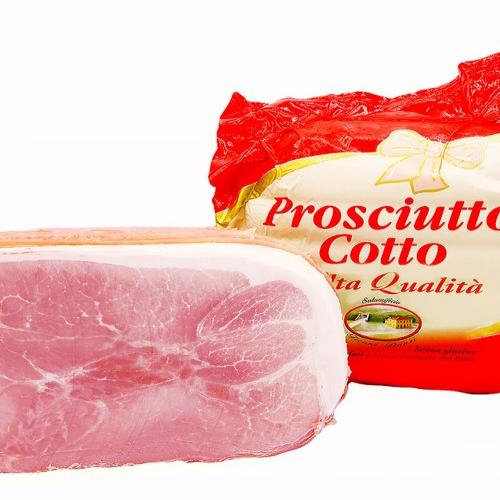
The Cooked Ham from the Salumificio Freoni Danzi is a product classified as high quality, originally processed from selected legs, flavored with spices and aromas, steamed and vacuum packed and pasteurized. Cooked Ham: Historical Notes Cooked ham is a food with a long history and tradition, dating back to ancient Rome, where traces of recipes for processing pork meat have been found. Cooked ham is nothing more than a "large roast" and therefore its discovery is attributed to the Romans who, during wars in Northern European regions, sought to facilitate the cooking of roasted pork legs by boiling them in water and flavors. Its production requires some essential phases: the selection and slaughter of the pig, the processing of the hind limb, steaming, and packaging. Cooked Ham: Nutritional Values Cooked ham is not only a source of protein, but it is also rich in zinc, iron, mineral salts, and B vitamins, making it a complete food from a nutritional point of view. The energy quantity provided to our body varies depending on the amount of fat maintained during the skinning process. How do you determine if a ham is of quality? Quality depends on the amount of water present in the meat, particularly the more moist the ham is, the lower the quality. You also need to be careful about what you buy; often, cooked ham is replaced by a very similar product, but of lesser quality: cooked pork shoulder. A Cooked Ham: Three Different Qualities You may not know that, as a result of a decree from the Ministry of Productive Activities in 2005, there are three categories of this cold cut that reflect three levels of quality. The one simply called "cooked ham" is the base product, made through the processing of the pork leg. All hams with a moisture content of less than or equal to 81% fall into this category. The second category is called "selected cooked ham"; to fall into this classification, at least three of the four main muscles of the pork leg must be visible, and its moisture content must be equal to or less than 78.5%. The third category is represented by "high quality cooked ham" which, unlike the selected one, is more prized and sought after as it necessarily requires the use of boneless leg: its processing allows for a ham with a moisture content of less than 75.5%.
Shipping costs £40.16, free over £249.40
Price VAT included







The Cooked Ham from the Salumificio Freoni Danzi is a product classified as high quality, originally processed from selected legs, flavored with spices and aromas, steamed and vacuum packed and pasteurized. Cooked Ham: Historical Notes Cooked ham is a food with a long history and tradition, dating back to ancient Rome, where traces of recipes for processing pork meat have been found. Cooked ham is nothing more than a "large roast" and therefore its discovery is attributed to the Romans who, during wars in Northern European regions, sought to facilitate the cooking of roasted pork legs by boiling them in water and flavors. Its production requires some essential phases: the selection and slaughter of the pig, the processing of the hind limb, steaming, and packaging. Cooked Ham: Nutritional Values Cooked ham is not only a source of protein, but it is also rich in zinc, iron, mineral salts, and B vitamins, making it a complete food from a nutritional point of view. The energy quantity provided to our body varies depending on the amount of fat maintained during the skinning process. How do you determine if a ham is of quality? Quality depends on the amount of water present in the meat, particularly the more moist the ham is, the lower the quality. You also need to be careful about what you buy; often, cooked ham is replaced by a very similar product, but of lesser quality: cooked pork shoulder. A Cooked Ham: Three Different Qualities You may not know that, as a result of a decree from the Ministry of Productive Activities in 2005, there are three categories of this cold cut that reflect three levels of quality. The one simply called "cooked ham" is the base product, made through the processing of the pork leg. All hams with a moisture content of less than or equal to 81% fall into this category. The second category is called "selected cooked ham"; to fall into this classification, at least three of the four main muscles of the pork leg must be visible, and its moisture content must be equal to or less than 78.5%. The third category is represented by "high quality cooked ham" which, unlike the selected one, is more prized and sought after as it necessarily requires the use of boneless leg: its processing allows for a ham with a moisture content of less than 75.5%.